
Hydroseeding is not enough for erosion control when the site is losing soil because of concentrated runoff, unstable ground, active washouts, or other forces that vegetation cannot address by itself. It works best where establishing plant cover will protect a surface that is otherwise capable of remaining stable. When the cause of erosion extends beyond exposed soil, hydroseeding needs to be considered as one part of the solution rather than the entire solution, which is an important distinction when planning erosion control with Jade Blade Hydroseeding.
Hydroseeding Controls Erosion by Establishing Vegetation
Hydroseeding establishes vegetation by applying a slurry containing seed, mulch, fertilizer, water, and other specified materials to prepared soil. Jade Blade Hydroseeding uses this process to establish plant cover across suitable residential, commercial, industrial, and disturbed-ground applications.
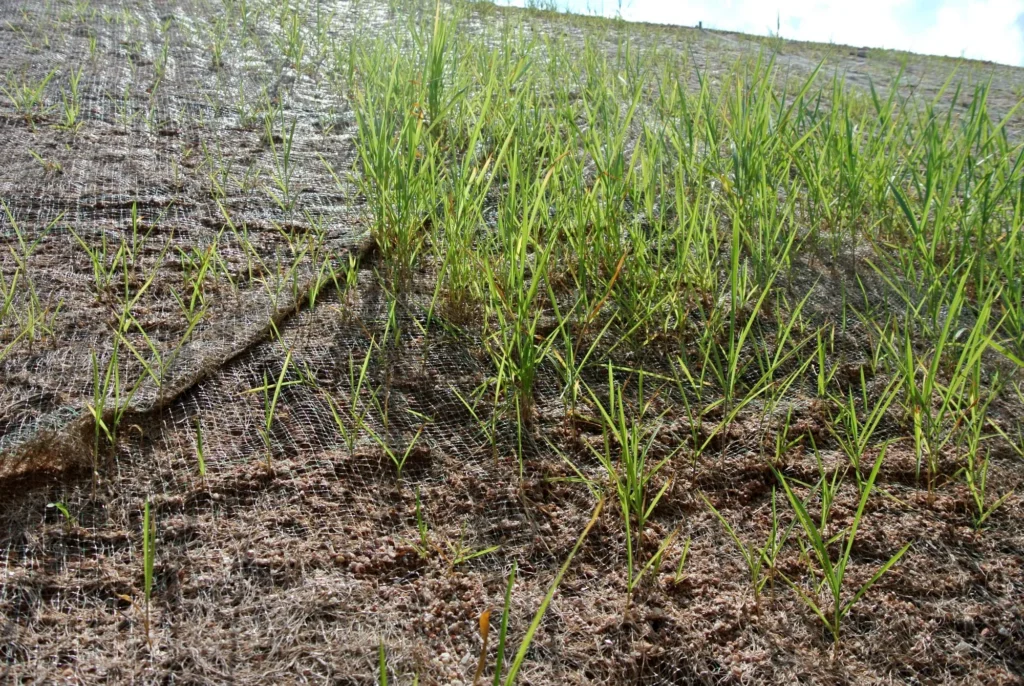
As vegetation develops, plant cover reduces direct rainfall impact on exposed soil, while roots help hold near-surface soil in place. This makes vegetation useful for controlling surface erosion where runoff remains relatively dispersed and the underlying ground is stable.
The mulch and tackifier used in a hydroseed application can provide some temporary surface protection during establishment. They do not correct drainage problems, stabilize a physically failing slope, or control significant concentrated flow. Long-term erosion protection therefore depends on establishing vegetation under conditions where the soil can remain in place while that vegetation develops.
Conditions Where Vegetation Alone May Not Stabilize the Site
The key question is whether erosion is primarily being caused by exposed soil or by a stronger underlying force. Vegetation can protect a stable surface, but it should not be expected to compensate for uncontrolled runoff or ongoing soil movement.
| Site condition | Why hydroseeding alone may be insufficient | What needs to be addressed |
| Concentrated water flow | Water moving through a defined path can scour soil faster than vegetation can protect it | The source, direction, and concentration of runoff |
| Steep or unstable slopes | Slope conditions can increase runoff and soil movement, while instability may extend below the vegetated surface | Slope condition, drainage, soil stability, and required reinforcement |
| Active rills, gullies, or washouts | Existing channels show that runoff is already removing soil along a repeated path | The cause of the concentrated flow and the damaged area |
| Highly erodible or poorly structured soil | Soil may be easily displaced or may not provide suitable conditions for vegetation establishment | Soil preparation, growing conditions, and whether additional stabilization is required |
Concentrated Water Flow
Hydroseeding becomes less suitable as a stand-alone measure when runoff collects into a defined route instead of remaining spread across the surface.
Concentrated flow places greater erosive force on a smaller area. It can remove soil, disturb a new hydroseed application, and continue cutting a channel even after some vegetation develops.
Where this is occurring, the source and path of the runoff need to be addressed. Hydroseeding can still be used on surrounding or stabilized ground, but reseeding an active flow path without managing the water leaves the original erosion mechanism in place.
Steep or Unstable Slopes
A steep slope does not automatically rule out hydroseeding. Slope suitability depends on factors such as soil condition, drainage, runoff exposure, slope length, and whether the surface can retain soil and the hydroseed application during establishment.
Problems arise when the slope is already losing soil or when runoff gains enough concentration to move material downslope before vegetation can establish.
Physical slope instability is a separate concern. Slumping, cracking, deeper soil movement, or signs of slope failure can indicate a problem beyond surface erosion. These conditions require appropriate site assessment before surface stabilization or revegetation methods are selected.
Active Rills, Gullies, or Washouts
Rills, gullies, and recurring washouts show that water is repeatedly removing soil along a defined route. Applying hydroseed directly over these areas does not remove the cause of the erosion.
Even if seed germinates, another runoff event can damage the new vegetation if water continues following the same path.
The active erosion source should therefore be addressed before the area is reseeded. Once the damaged ground is stabilized and water movement is controlled, hydroseeding can be used where vegetation is appropriate for restoring surface cover.
Highly Erodible or Poorly Structured Soil
Highly erodible soil and poor growing conditions create different limitations. Soil that is easily displaced may require additional surface stabilization so it remains in place during rainfall or runoff. By comparison, heavily compacted or poorly structured soil may restrict root development, water infiltration, or establishment of healthy vegetation.
These conditions should not be treated as the same problem. Soil preparation, conditioning, amendments, or additional stabilization may be appropriate depending on whether the primary issue is erosion susceptibility, poor growing conditions, or both.
Jade Blade Hydroseeding provides soil preparation and erosion-control services alongside hydroseeding, allowing the treatment to be matched to the site’s actual limitations.
The Establishment Period Creates a Temporary Vulnerability
Hydroseeding does not produce rooted vegetation immediately. Seed must germinate and develop enough coverage and root growth before vegetation provides meaningful long-term surface protection.
During this period, newly seeded soil remains more vulnerable to heavy rainfall, runoff, and disturbance. Mulch and tackifier helps hold the application in place, but they should not be treated as equivalent to established vegetation or dedicated stabilization where erosion risk is significant.
This matters most on sites where substantial soil loss could occur before vegetation becomes established. In those situations, the site may require temporary protection during the establishment period rather than relying only on future plant growth.
When Additional Stabilization May Be Needed Before Vegetation Establishes
Additional stabilization may be needed when vegetation is appropriate for the site long term but the soil requires greater protection during establishment.
The type of protection depends on the conditions present. Slope severity, soil composition, runoff exposure, terrain, compaction, and the consequences of surface movement all influence what level of stabilization is appropriate.
Surface-stabilization measures may help protect exposed soil from rainfall or temporary erosion during establishment, but their suitability is site-specific. A measure that works on a relatively stable slope may not be appropriate where runoff is concentrated or the ground itself is unstable.
The key distinction is whether the site needs temporary protection while vegetation develops or whether the underlying erosion mechanism must be corrected before revegetation begins.
Fix the Source of Erosion Before Reseeding Repeated Failures
Repeated hydroseeding failure should trigger an assessment of why the previous application was lost rather than another identical reseeding attempt.
The failure pattern can provide useful information. Seed and mulch disappearing along one route may indicate concentrated drainage. Repeated soil loss after storms may point to grading or runoff problems. Poor or uneven establishment without visible washout may instead suggest unsuitable soil preparation or growing conditions.
Before reseeding, identify whether the previous failure resulted from water movement, soil instability, poor establishment conditions, or another site-specific factor.
Once the reason for the failure has been addressed, hydroseeding can be used again where vegetation remains an appropriate long-term surface treatment.
Choosing Between Hydroseeding Alone and a Broader Erosion-Control Approach
The decision should be based on what is causing the soil loss.
- Hydroseeding alone may be suitable when the soil and grade are stable, runoff remains dispersed, and the primary need is to establish vegetation over exposed ground.
- Hydroseeding with additional surface stabilization may be suitable when vegetation is appropriate long term but the soil needs greater protection during germination and establishment.
- A broader erosion-control approach is needed when concentrated runoff, active washouts, or unstable ground will continue removing soil regardless of whether seed is applied.
- Repeatedly failed areas require reassessment before reseeding because another application will not correct an unchanged drainage, soil, or stability problem.
- Combined conditions require a site-specific decision. Slope, soil condition, drainage, runoff exposure, and the ability of vegetation to establish all affect whether hydroseeding should be used alone or alongside other measures.
The objective is to determine whether vegetation addresses the erosion mechanism present on the site rather than assuming every exposed area requires the same treatment.
Hydroseeding and Erosion-Control Planning With Jade Blade Hydroseeding
Jade Blade Hydroseeding provides hydroseeding, erosion-control, soil-preparation, and soil-stabilization services for residential, commercial, industrial, development, and disturbed-ground applications.
The appropriate service depends on the conditions present at the site. Hydroseeding may be sufficient where the surface is stable and the main objective is establishing vegetation. Projects involving concentrated runoff, difficult slopes, unstable soil, or repeated erosion may require additional site preparation or stabilization before vegetation can provide reliable long-term protection.
Jade Blade assesses relevant site conditions when determining how hydroseeding fits into an erosion-control project. The goal is to match the treatment to the cause of the soil loss instead of relying on reseeding where drainage, soil condition, or stability remains unresolved.