
Hydroseeding without an irrigation system is practical when the property has enough water, suitable distribution equipment, and a realistic plan for maintaining moisture throughout the seeded area. Automated irrigation simplifies this work, but it is not required. The decision depends on whether the site can be watered evenly under its expected soil and weather conditions. Jade Blade Hydroseeding considers these factors when planning residential, acreage, commercial, and rural hydroseeding projects.
Hydroseeding Needs Consistent Moisture, Not Necessarily Automated Irrigation
The water included in the hydroseeding slurry supports application, while the mulch slows moisture loss around the seed. Neither replaces supplemental watering during establishment. The mulch should remain damp, and the soil immediately beneath it should feel moist rather than dry, muddy, or saturated.
Too little water interrupts germination and can kill newly emerged seedlings. Excessive water restricts oxygen in saturated soil and may move seed and mulch through pooling or runoff. The green colour of the mulch is not a reliable moisture indicator because the dye fades after application.
Permanent irrigation provides convenient and repeatable coverage. Hoses, portable sprinklers, temporary irrigation lines, tanks, and coordinated water delivery also work when they provide comparable control and reliability. Mulch selection and application rate may slow drying, but they do not remove the need for ongoing moisture.
Visible growth does not mean the entire seeded area has finished germinating. Seed varieties within a mixture may emerge at different rates, so moisture maintenance should follow the care guidance for the complete application rather than the first visible seedlings.
When Hydroseeding Without Irrigation Can Work
Three factors determine whether a non-permanent watering setup is workable: the reliability of the water source, the amount of ground that must be covered, and the soil’s ability to absorb and retain water.
Reliable Access to Hose or Portable Water
A hose connection must supply enough flow and pressure for the intended sprinkler configuration. Test the actual equipment at the farthest watering point before hydroseeding, particularly when several sprinklers or hose splitters will operate at once.
Wells, cisterns, tanks, and hauled-water systems require additional checks. Available volume, recovery rate, refill time, pump output, and other property demands must leave enough water for the seeded area. Household use, livestock, site operations, or fire-protection reserves may reduce the amount available for establishment.
Water quality also matters. Dugout, reclaimed, saline, sediment-heavy, or chemically affected water may be unsuitable without further assessment or filtration.
Manageable Seeding Area
There is no universal maximum area that can be watered without permanent irrigation. The practical limit is the amount of ground the available system can cover before the earliest completed zone begins to dry.
Measure how long the intended sprinklers take to cover every zone under normal operating pressure. Adding more sprinklers only increases capacity when the water source maintains adequate flow across them. If the full area exceeds the available capacity, temporary lines, additional water storage, contracted watering, or phased hydroseeding may be required.
Soil That Retains Moisture Effectively
Suitable soil absorbs water without immediate runoff while retaining moisture near the seed between applications. Prepared topsoil with balanced drainage generally makes non-permanent watering more manageable.
A simple pre-installation watering test helps identify limitations. Water should enter the soil rather than remain on the surface, run downhill, or disappear so quickly that the upper layer immediately dries. Soil preparation or amendment may be required when infiltration and retention are poorly balanced.
When Lack of Irrigation Becomes a Serious Limitation
The limitation becomes unacceptable when the site’s establishment requirements exceed the available water supply, distribution capacity, or ability to monitor the seeded ground.
Large Acreages With Limited Water Access
A large acreage may be hydroseeded faster than it can be maintained with a single residential hose, small well, or portable tank. Tank capacity alone does not determine feasibility. Refill distance, hauling time, pump output, and the number of daily trips affect whether water can be delivered reliably.
Dividing the property into smaller phases reduces the amount of new hydroseed requiring attention at one time. If the available setup cannot maintain even the reduced phase, hydroseeding should wait until watering capacity improves.
Hot, Dry, or Exposed Sites
A site becomes impractical when moisture is lost faster than the available equipment can complete and repeat coverage. The watering setup may need more available water, additional active zones, faster equipment repositioning, and closer monitoring during hot or windy conditions. If those requirements cannot be met during the expected installation weather, delaying the application reduces the risk of failed or uneven establishment.
Properties That Cannot Be Watered Consistently
Hydroseeding is generally unsuitable when nobody can inspect the ground, operate or reposition equipment, and respond to interrupted water service. Restricted site access, unstaffed weekends, unreliable wells, and equipment that cannot be monitored create predictable gaps in care.
Rainfall reduces supplemental watering only when it provides adequate and reasonably even moisture across the seeded area. Forecast probability and recorded rainfall totals do not confirm that the mulch and underlying soil remain moist. Conditions should be checked directly after the rain, especially beneath trees, beside structures, on slopes, and along exposed edges.
Watering Options for Properties Without Permanent Irrigation
The appropriate watering method depends on the available source, seeded area, terrain, and site access.
- Portable sprinklers and hoses: Suitable for smaller areas when hose reach, flow, and pressure support complete coverage.
- Handheld watering: Appropriate for small sections, edges, and areas missed by sprinklers. It is usually too labour-intensive for complete coverage of a large site.
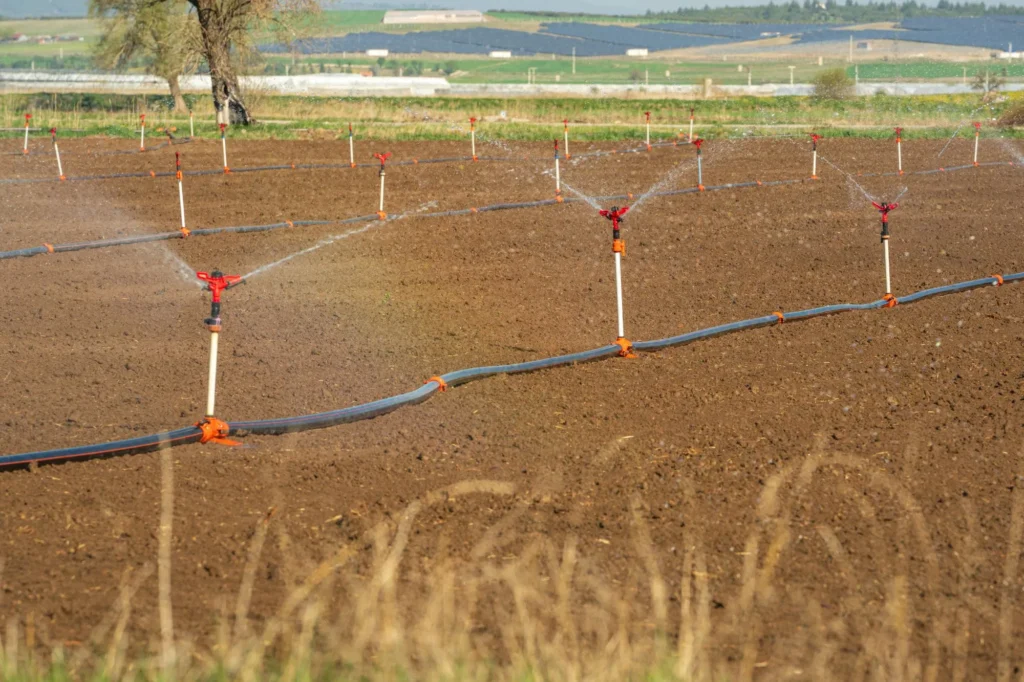
- Temporary above-ground irrigation: Timers, manifolds, hoses, and multiple sprinkler zones reduce manual repositioning across medium or irregular areas.
- Water tanks with pumps: Useful where no permanent connection exists, provided tank volume, pump pressure, water quality, and refill logistics meet the site’s requirements.
- Water trucks or contracted watering: Suitable for some acreage and commercial sites when the equipment distributes water gently rather than releasing a concentrated flow that disturbs the mulch.
- Rainfall with supplemental watering: Practical when another water source remains available for light rainfall, uneven precipitation, and dry periods.
Timers and multiple zones reduce labour but do not remove the need for inspection. Sprinkler blockages, pressure loss, wind drift, leaks, and equipment failure may leave sections dry even when the system operates on schedule.
The complete setup should be tested before hydroseeding. The test should confirm actual coverage, operating pressure, refill requirements, and the time needed to reach every zone.
How Site Conditions Change the Watering Requirement
Properties of the same size may require different watering capacity because moisture loss, infiltration, and drainage vary across the site.
| Site Condition | Effect on Moisture | Practical Watering Consideration |
| Sandy or coarse soil | Drains and dries quickly | Check moisture more frequently and maintain dependable coverage |
| Loam or amended topsoil | Balances retention and drainage | Generally supports more manageable watering intervals |
| Heavy or compacted soil | Accepts water slowly and may become saturated | Apply water gently to improve infiltration and prevent pooling |
| Sloped ground | Produces runoff when water is applied faster than the soil absorbs it | Use lower-intensity distribution that allows water to soak in |
| Full sun or southern exposure | Increases surface temperature and evaporation | Allow for greater watering capacity than a shaded area of equal size |
| Open or windy terrain | Accelerates moisture loss from exposed mulch | Monitor edges, elevated sections, and areas outside sprinkler overlap |
| Shaded ground | Loses moisture more slowly | Adjust coverage to avoid applying the same amount required by exposed sections |
| Low-lying ground | Collects drainage from surrounding areas | Reduce application when necessary to prevent prolonged saturation |
Conditions must be assessed together. Shade may reduce the drying pressure created by coarse soil, while wind, full sun, and slope may compound it. The watering plan should reflect the most demanding sections without oversaturating areas that remain moist longer.
Deciding Whether Hydroseeding Is Practical for Your Property
Complete a trial using the intended water source, hoses, pumps, sprinklers, and zone layout. Record the time needed to cover the entire proposed area and confirm that the source maintains sufficient volume and pressure throughout the test.
Check municipal watering restrictions, permitted watering hours, well capacity, source-use limitations, and water-delivery availability. These restrictions may make an otherwise workable setup impractical during the establishment period.
The property is suitable when the tested system covers every zone before the earliest section dries and responsible personnel are available to monitor the site. The plan should also include a workable response to pump failure, water interruption, unexpected heat, or missed rainfall.
If those conditions cannot be met, reduce the application area, improve the watering setup, change the installation timing, or postpone hydroseeding.
Planning Hydroseeding Without Irrigation With Jade Blade Hydroseeding
For project planning, provide the property location, approximate seeding area, water source, tested flow and coverage, soil condition, terrain, site exposure, and intended watering equipment. Jade Blade Hydroseeding uses these details to identify whether the proposed installation area matches the property’s watering capacity. The review establishes whether the project should proceed as one application, be divided into manageable phases, or wait until a more reliable watering arrangement is available.