
Hydroseeding vs sod is a common decision for Edmonton property owners who want to balance budget, timeline, and long-term lawn performance. The right choice depends on how quickly the area needs to look finished, how much disturbance the site will face during early growth, and how large the area is. Disturbance includes foot traffic, pets, uneven watering, and exposure to wind or dry conditions. New builds, large grading projects, and acreage developments often use hydroseeding for coverage efficiency, while sod is used where a finished lawn is expected immediately after construction. Both options require proper soil preparation, including grading, topsoil quality, and compaction correction before installation. Jade Blade Hydroseeding compares both methods through that practical lens.
Upfront Cost Comparison
Hydroseeding typically costs less upfront, especially on larger residential lots, commercial properties, and acreage. Sod costs more because it includes mature turf that growers produce, cut, transport, and install. Upfront cost usually includes materials, labour, and standard site preparation, but it often excludes irrigation setup and ongoing watering. This difference makes hydroseeding the practical starting point when budget drives the decision, especially on standard lots and larger areas.
Early maintenance also affects perceived cost. Hydroseeding requires consistent watering during germination, while sod needs steady watering to establish root contact. Both demand attention, but hydroseeding often requires more consistency early on.
Cost Per Square Foot
Hydroseeding costs less per square foot in most Edmonton projects. The cost gap increases as project size grows because crews cover large areas faster without handling and placing individual sections. Site conditions still affect pricing, including grading quality, access, and soil condition.
On smaller or irregular areas, the cost gap shrinks. Setup, prep, and mobilization make up a larger portion of the total cost, which reduces the advantage. Sod costs more because it arrives as finished turf, and that difference shows most clearly on larger open areas rather than small sections.
Installation Labour Differences
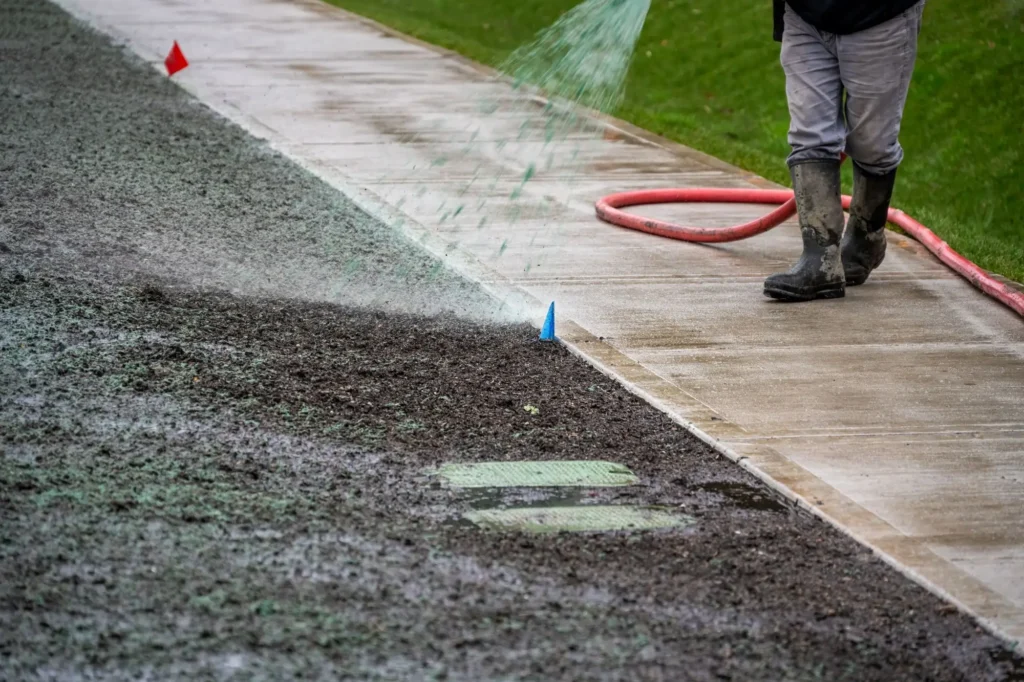
Labour requirements differ between the two methods. Crews apply hydroseeding quickly using specialized equipment, which requires hose access and site entry. Crews install sod by placing and adjusting each roll by hand, which increases labour time and cost.
Weather and soil conditions affect both methods. Wet or unstable soil slows sod installation, while heavy rain or wind can delay hydroseeding or affect even coverage. Labour differences also impact scheduling. Hydroseeding allows faster completion on large areas, while sod installation takes longer on complex layouts or restricted sites.
Large Property Cost Implications
Sod becomes expensive on large properties due to material volume and labour, especially on multi-thousand square foot areas or acreage. It still works, but the cost increases quickly unless the project requires immediate visual results.
Hydroseeding fits large lots, acreage, and commercial land because it scales efficiently. However, large hydroseeded areas require consistent irrigation during early growth. If the site cannot support reliable watering, hydroseeding becomes harder to manage.
Establishment Timeline and Usability
The main tradeoff between hydroseeding and sod is establishment speed. Sod creates an immediate green surface, but it still needs time to root. Hydroseeding takes longer to grow in, but it builds from seed into the site conditions. Both methods perform best during active growing seasons in Edmonton.
Late-season installation creates risk. Sod may not root fully before cold weather. Hydroseeding may not establish enough growth before dormancy.
Time to Germination
Hydroseeded lawns do not appear immediately. Under typical Edmonton conditions, grass usually begins to germinate within one to three weeks, depending on seed type, temperature, and moisture. If growth appears uneven or delayed, crews often correct it with spot reseeding rather than replacing the entire area.
When the Lawn Can Handle Foot Traffic
Sod handles light use sooner than hydroseeding, but only after it begins to root into the soil. Early foot traffic can shift sod, separate seams, or prevent proper rooting. It looks ready before it actually is.
Hydroseeded lawns require more time before use. Grass must germinate, root, and thicken before it handles traffic. In most cases, sod can handle light use within a few weeks once rooting begins. Hydroseeded lawns need a longer period before regular use. Early use in either case reduces density and long-term durability.
Visual Results in the First 30–60 Days
During the first 30 to 60 days, sod looks complete and uniform because it provides full coverage from day one. Hydroseeding develops gradually. Early growth often looks uneven, with some areas filling in faster than others.
This uneven appearance is normal during early growth and usually corrects as the lawn thickens. If certain areas remain thin beyond expected timelines, crews correct them with spot reseeding.
Long-Term Performance in Alberta’s Climate
Long-term performance in Alberta depends more on preparation, seed or turf selection, watering, and establishment timing than the initial method. Common stress factors include freeze-thaw cycles, dry summer periods, and moisture-related issues such as snow mold.
Hydroseeding allows grass to develop directly in the site soil, which supports long-term adaptation. Sod also performs well when it roots properly into the soil below. If roots fail to establish, durability drops.
Poor maintenance affects both methods. Sod that does not root can deteriorate quickly. Hydroseeded lawns may never reach full density if watering or early care is inconsistent. Repair methods differ. Crews repair hydroseeded lawns with reseeding that blends naturally. Sod repairs require cutting and replacing sections, which often creates visible differences and higher labour effort.
Which Option Fits Your Property and Goals?
Sod fits projects that require immediate appearance or faster short-term usability. It works when the budget allows for higher upfront cost in exchange for instant coverage.
Hydroseeding fits projects that prioritize cost efficiency, large coverage areas, and long-term value. It works when the site allows time for proper establishment.
Soil condition and grading also affect the decision. Poor preparation limits both methods, so site readiness matters as much as method choice. Some projects use a hybrid approach. High-visibility or high-traffic areas use sod, while larger surrounding areas use hydroseeding to control cost.
Key decision factors include budget, timeline, property size, and ability to manage watering and protection during early growth.
| Hydroseeding vs Sod | Hydroseeding | Sod |
|---|---|---|
| Cost | Lower upfront cost on most projects | Higher upfront cost due to mature turf and labour |
| Timeline | Slower to germinate and fill in | Immediate green coverage |
| Maintenance During Establishment | Requires consistent watering and protection during early growth | Requires watering and care while roots establish |
| Durability (Long-Term) | Develops strong root systems in native soil when established properly | Performs well when roots establish fully, weakens if installation or care is poor |
| Repairability | Crews reseed damaged areas with minimal visual difference | Crews replace sections, which may remain visible and require more labour |
Leave a Comment